
#11 King Midas in Reverse(the1990s)
Still wonder why Team Trump is betraying Ukraine? In this episode, Trump's bloated empire starts to totter, everything he touches turns to dross, and the Russians come to his rescue yet again!

By the start of the Nineties, the KGB, having “spotted” Donald Trump as a promising asset, had arranged his first trip to Moscow, and pumped him full of KGB talking points that were published in three of America’s most prestigious newspapers. (See 1987 The New Manchurian Candidate.) At the same time, Trump had been hogging the media spotlight in New York. But increasingly, Trump’s thirst for the limelight served primarily to show the entire world what a lousy businessman he was.
After his initial success with the Hyatt Grand Central (see1980 Former Soviet Agent: How Trump Was Lured into the KGB’s Web) and the sensational spectacle known as Trump Tower(1985-86 The KGB Sets Its Trap), Trump’s luck had turned south. In 1984, he bought the New Jersey Generals in the USFL football league. Later, he bought Eastern Airlines’ New York–Boston–Washington routes for $365 million and transformed it into the Trump Shuttle, making sure its flight attendants were accessorized with pearls. Both ventures became money pits that failed miserably.
Trump was King Midas in reverse. Everything he touched turned to dross. His biggest problems grew out of his casinos in Atlantic City, New Jersey. As I reported in House of Trump, House of Putin:
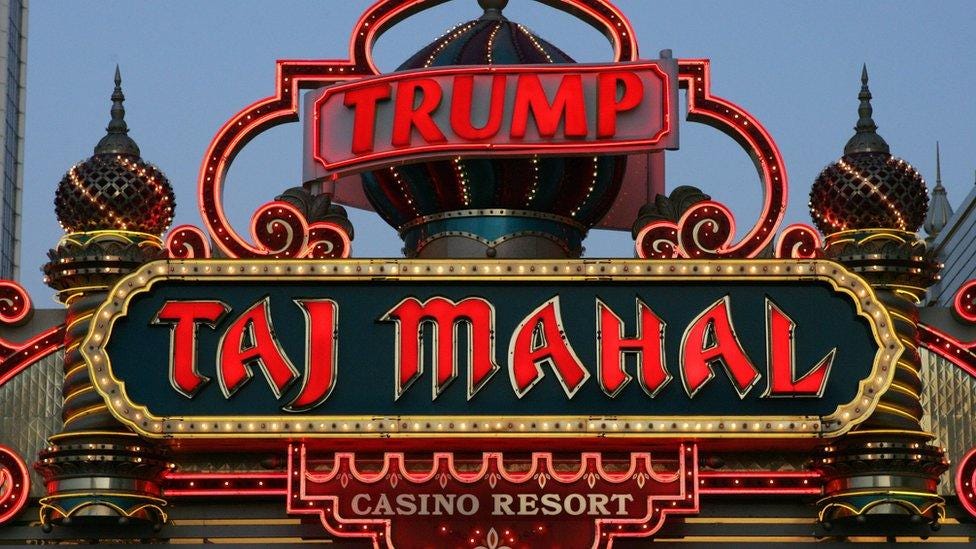
As early as 1990, Trump’s casinos were in so much trouble that, far from being a multibillionaire, as he claimed, Trump actually had a negative net worth. Indeed, at a time when payments on more than $1 billion worth of bonds on his casinos came due every ninety days, he was down to his last $1.6 million. Then, in 1991, the Trump Taj Mahal, the $1.2 billion casino Trump touted as the “eighth wonder of the world,” became the first of six Trump bankruptcies. As these fiascos took place, Trump structured his bankruptcies so he could sell off his stocks and reap millions while investors lost their shirts. But even that wasn’t enough to allow his empire to remain intact.
Thanks to personal liabilities exceeding $900 million, one after another, Trump’s three Atlantic City casinos and the Plaza Hotel slipped out of his grasp. Other assets, such as the Trump Shuttle and his 282-foot yacht, the Trump Princess, were casualties as well.
Indeed, according to The Moscow Project, if you had just started work at the Trump Organization, as executive vice-president Abraham Wallach did in 1990, then it felt like boarding “the Titanic just before the women and children were moved to the lifeboats.” At the time, the Trump Organization was reportedly $3.4 billion in debt, with Trump himself liable for more than $800 million. The next year, as debt soared for Trump’s hotels and casinos, the New Jersey Casino Control Commission concluded, “Mr. Trump cannot be considered financially stable.”
All of which meant that Trump was beginning a new chapter in his life. His marriage to Ivana had produced three children—Donald Jr., Ivanka, and Eric—but Trump had begun a highly publicized relationship with Marla Maples. He and Ivana were headed toward divorce. At the same time, his massive losses in Atlantic City had made it very difficult for him to get financing, which paralyzed any future development. In the past, the Italian Mafia had been crucial to his family’s success. They had helped his father’s projects. They had helped Donald develop Trump Tower, giving him secure access to ready-mix concrete. Mob-connected lawyers like Roy Cohn had always been there for him. But Cohn had died in 1986.
This time, however, he had the Russians.
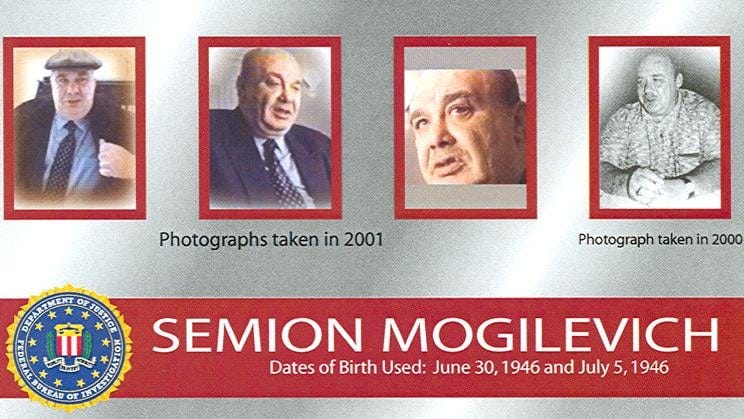
As noted in 1984 Trump’s Russian Laundromat, shortly after Trump Tower dazzled the real estate world, Russian mobsters began buying up Trump branded condos in order to launder money on a massive scale. That was the year—1984— that Trump reached out to David Bogatin, a leading figure in New York’s Russian Mafia plunked down $6 million in cash to buy five condos in Trump Tower. (Bogatin’s family ties led straight to the top of the Russian mob: His brother ran a $150 million stock scam with Semion Mogilevich, who the FBI called the “boss of bosses” of the Russian Mafia.)
Bogatin, however, was not the only one to launder money through Trump real estate. As I wrote in The New Republic, “at least 13 people with known or alleged links to Russian mobsters or oligarchs have owned, lived in, and even run criminal activities out of Trump Tower and other Trump properties. Many used his apartments and casinos to launder untold millions in dirty money. Some ran a worldwide high-stakes gambling ring out of Trump Tower—in a unit directly below one owned by Trump. Others provided Trump with lucrative branding deals that required no investment on his part. Taken together, the flow of money from Russia provided Trump with a crucial infusion of financing that helped rescue his empire from ruin, burnish his image, and launch his career in television and politics. “They saved his bacon,” says Kenneth McCallion, a former assistant U.S. attorney in the Reagan administration who investigated ties between organized crime and Trump’s developments in the 1980s.
Exactly how much money did the Russian bring in to the Trump empire? As I reported in House of Trump, House of Putin:
Because it is so difficult to penetrate the shell companies that purchased these condos, it is almost impossible for reporters—or, for that matter, anyone without subpoena power—to ascertain the scale at which such laundering may have taken place in Trump-branded properties. Nevertheless, according to a BuzzFeed investigation by Thomas Frank, more than 1,300 condos, one-fifth of all Trump-branded condos sold in the US since the eighties, were sold “in secretive, all-cash transactions that enable buyers to avoid legal scrutiny by shielding their finances and identities.” The BuzzFeed article added that the total value of these condo sales—sales that match the US Treasury’s criteria for possible money laundering—was about $1.5 billion, a figure that actually may understate the amount of dirty money in play. The article did not include Trump’s many buildings outside the United States, such as Trump-branded high-rises in Canada, the Philippines, Panama, Uruguay, Turkey, India, South Korea, and other countries where President Trump often licenses his name and collects royalties.
But real estate was not the only way in which the Russians were sending large infusions of cash into the tottering Trump empire. The Taj Mahal had become a favorite destination for the Russian mob because Trump made a point of giving high rollers “comps” for up to $100,000 a visit, an amenity that casinos often offered big-time gamblers. Later, two other Trump casinos, the Trump Castle Hotel and Casino, and the Trump Plaza Hotel and Casino, agreed to pay fines for “willfully failing to report” currency transactions over $10,000 and failing to comply with laws designed to prevent money laundering.
Cast of Characters
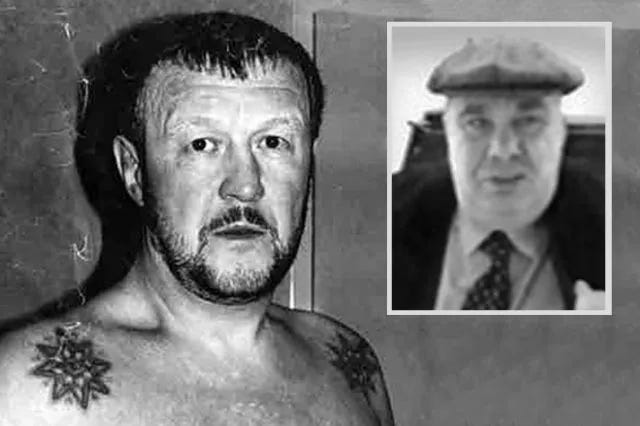
Vyaschlav Ivankov
Also known as Japonchik(“little Japanese”), Ivankov was a hardened vory v zakone who was sent to the US by Semion Mogilevich(below) to shore up the fortunes of Russian Mafia. The FBI looked all over for Ivankov before they realized that he was a regular at Trump’s Taj Mahal and had a condo in Trump Tower on Fifth Avenue.
Semion Mogilevich
The so-called “Brainy Don” of the Russian Mafia, Mogilevich is a billionaire best known for being his money laundering wizardry as well as schemes like the Red Daisy gasoline tax scam. behind its money laundering schemes
If you have tips, leads, or insights, please reach out—I am always looking for new information. And don’t forget to comment and share your thoughts!
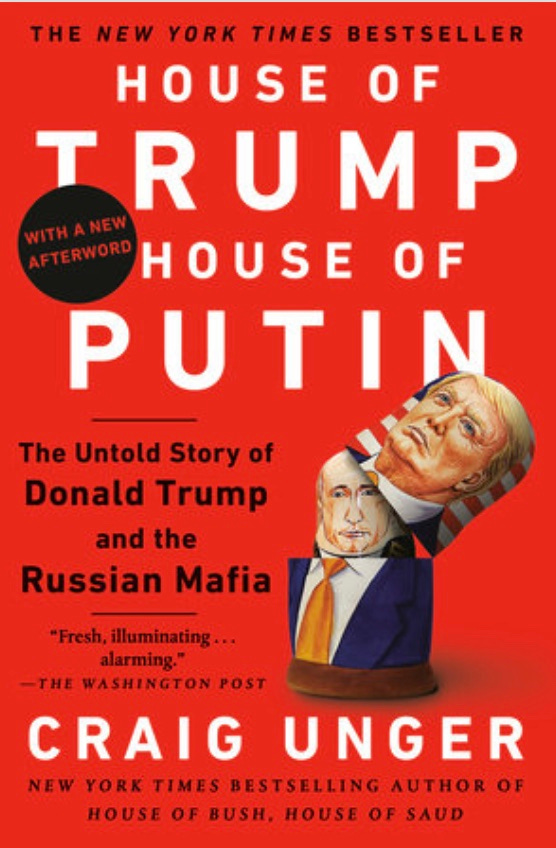
House of Trump, House of Putin
The Untold Story of Donald Trump and the Russian Mafia
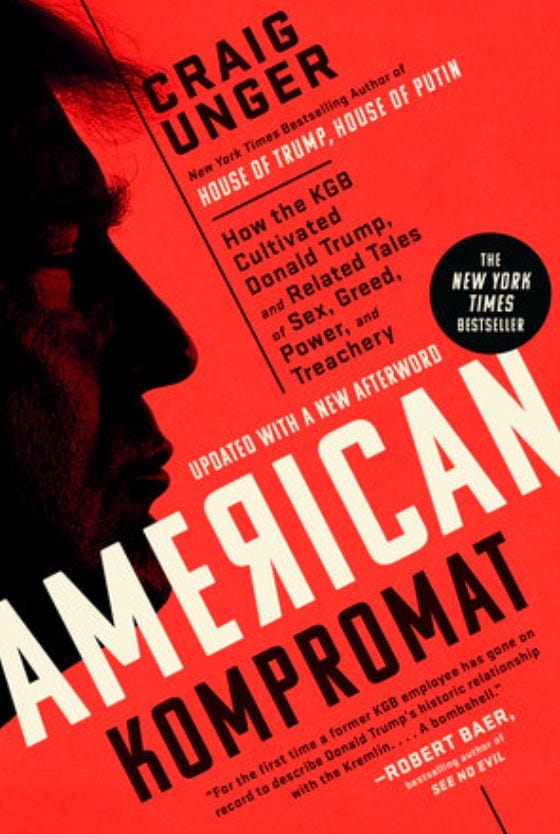
American Kompromat
How the KGB Cultivated Donald Trump, and Related Tales of Sex, Greed, Power, and Treachery
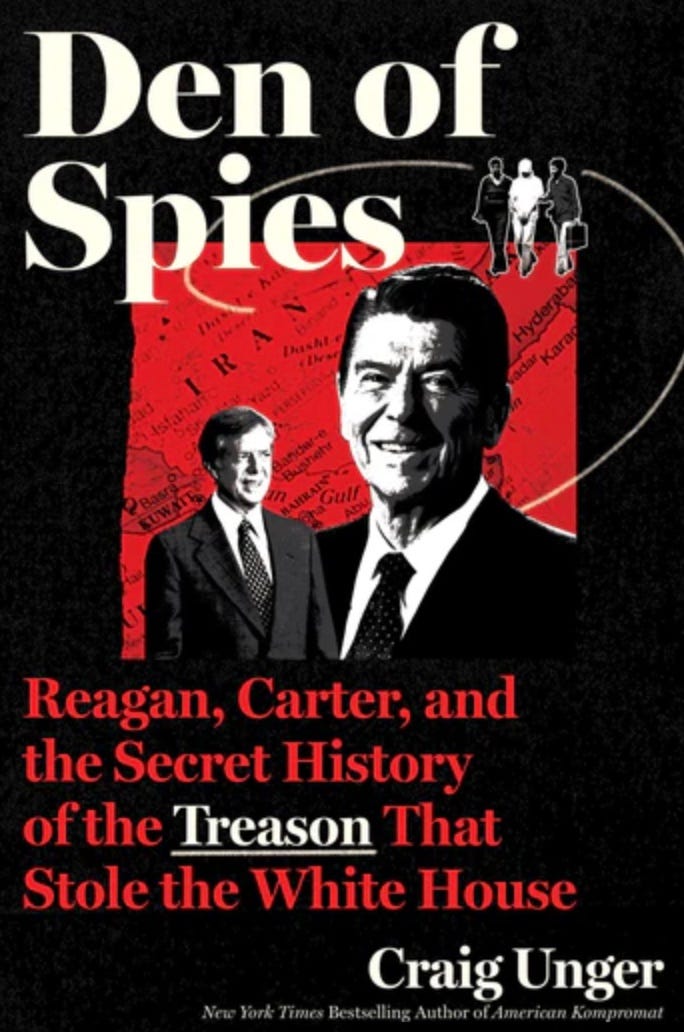
Den of Spies
Reagan, Carter, and the Secret History of the Treason That Stole the White House
Enjoyed the read, and so real!!! E
Agree with Elizabeth Graham.